English for meetings: phrases to open, interrupt, disagree and wrap up
Natural English phrases for every part of a meeting: opening, giving updates, interrupting, agreeing, disagreeing politely and wrapping up.

Michał Włosik
· 6 min read
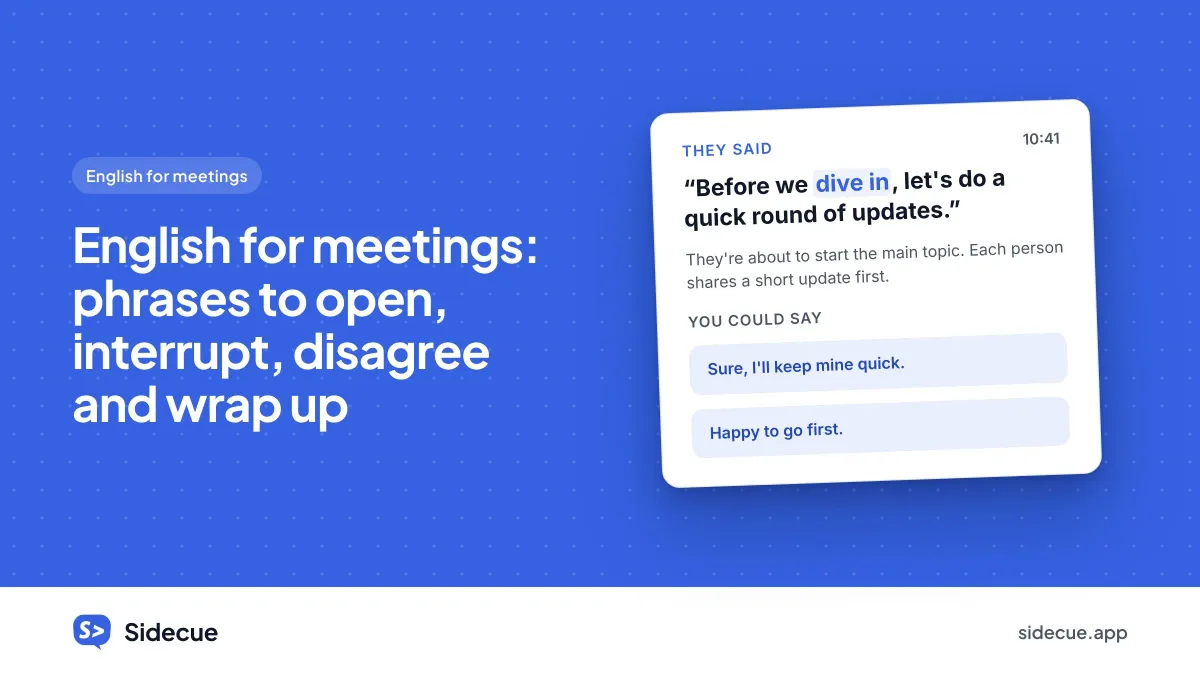
Most meetings follow the same shape: someone opens, people share updates, there's a discussion, maybe a disagreement, and then someone wraps up. If you have a few ready phrases for each moment, you spend less energy finding words and more on what you actually want to say.
This guide gives you natural English phrases for every part of a meeting, from the first “shall we start?” to the last “thanks, everyone”. They work in Google Meet, Zoom and Teams calls, and in the meeting room too.
Opening a meeting
If you run the meeting, a clear opening sets the tone. Say what the meeting is for and how long it will take.
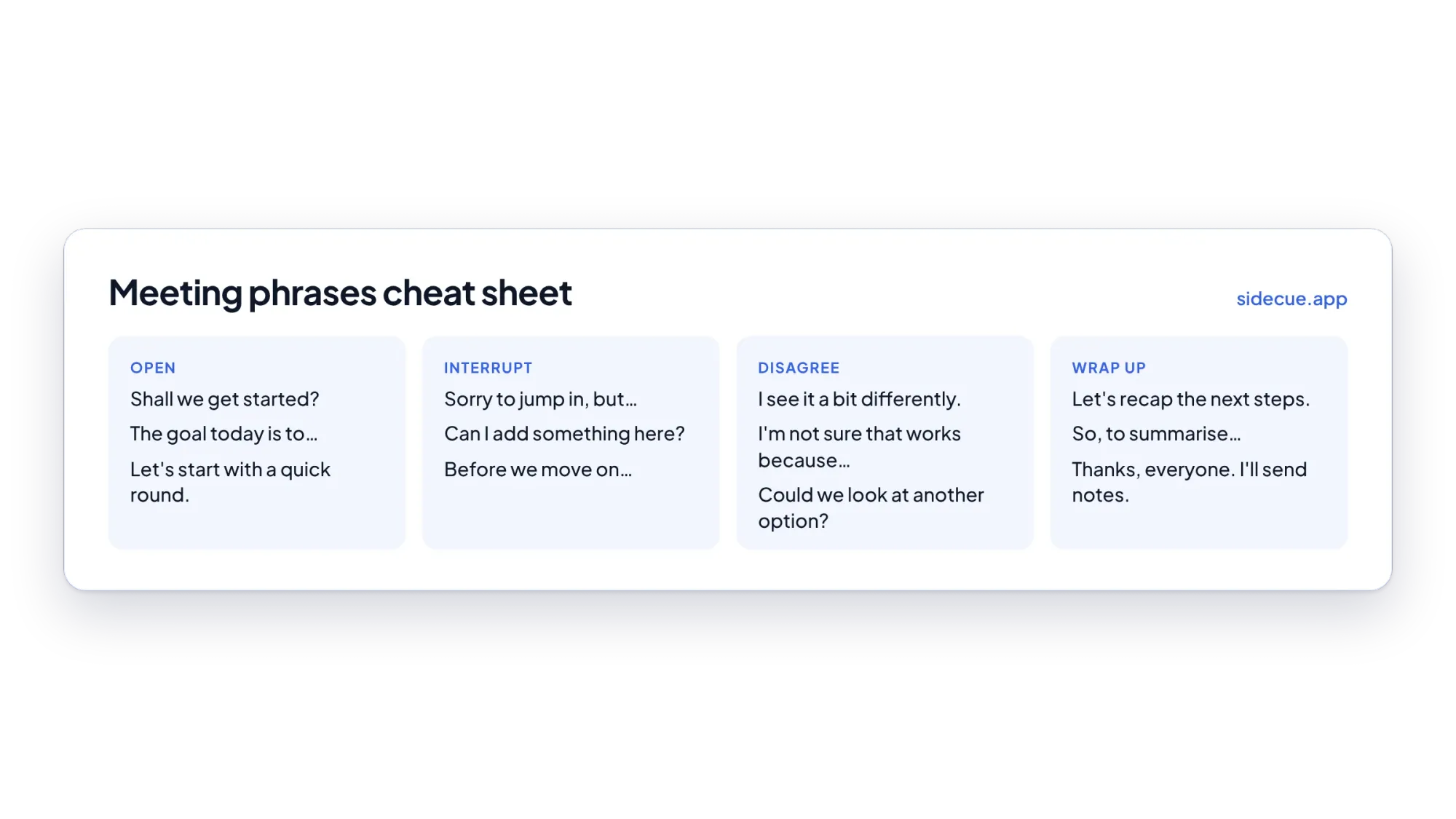
- “Shall we get started?” (friendly and very common)
- “Thanks for joining, everyone. Let's make a start.”
- “The goal today is to agree on the launch date.”
- “We've got 30 minutes, so I'll keep this tight.”
- “Let's start with a quick round of updates.”
- “Is everyone OK with the agenda, or is there anything to add?”
If someone is missing: “Let's give it two more minutes for Anna to join.” If you need to start anyway: “We'll start without Tom and catch him up later.”
Giving an update
A good update is short and in a predictable order: what's done, what's next, what's blocking you.
- “Quick update from my side: the design is finished.”
- “This week we're focusing on testing.”
- “We're on track for Friday.”
- “We're slightly behind because the data came in late.”
- “One thing that's blocking us is access to the server.”
- “That's all from me.” (a clear signal that you've finished)
“That's all from me” is worth learning on its own. In online calls, people often can't tell when you've finished, and it saves an awkward silence.
Presenting an idea or proposal
When you suggest something, give people a clear frame: the idea, the reason, and what you need from them.
- “I'd like to suggest a different approach.”
- “What if we tried a smaller pilot first?”
- “The main reason is that it cuts our costs by about a third.”
- “I'd love to get your thoughts on this.”
- “What I need from you today is a yes or no on the budget.”
The last phrase is one of the most useful in business English. It tells everyone exactly what decision the meeting should make.
Interrupting politely
Interrupting is hard in your second language, and harder online because of the delay. A short phrase first, then your point, works best. Say it a little louder than normal, then slow down.
- “Sorry to jump in, but…”
- “Can I add something here?”
- “If I could just come in on that point…” (more formal, common in British English)
- “Before we move on, can I ask a quick question?”
- “Just a quick thought on that…”
In video calls, you can also use the raise hand button or the chat: “I have a question when you have a moment.” It's polite and nobody has to stop mid-sentence.
When someone interrupts you
- “Sorry, can I just finish my point?”
- “Let me finish this thought and then I'll hand over.”
- “Good question. I'm coming to that in a second.”
Agreeing
Agreeing sounds simple, but “I agree” on its own can sound flat. Add a reason or build on the idea.
- “Exactly. That's what I was thinking.”
- “Good point. It would also save us time on testing.”
- “I'm with Sarah on this.”
- “That makes sense to me.”
- “I couldn't agree more.” (strong agreement)
Disagreeing politely
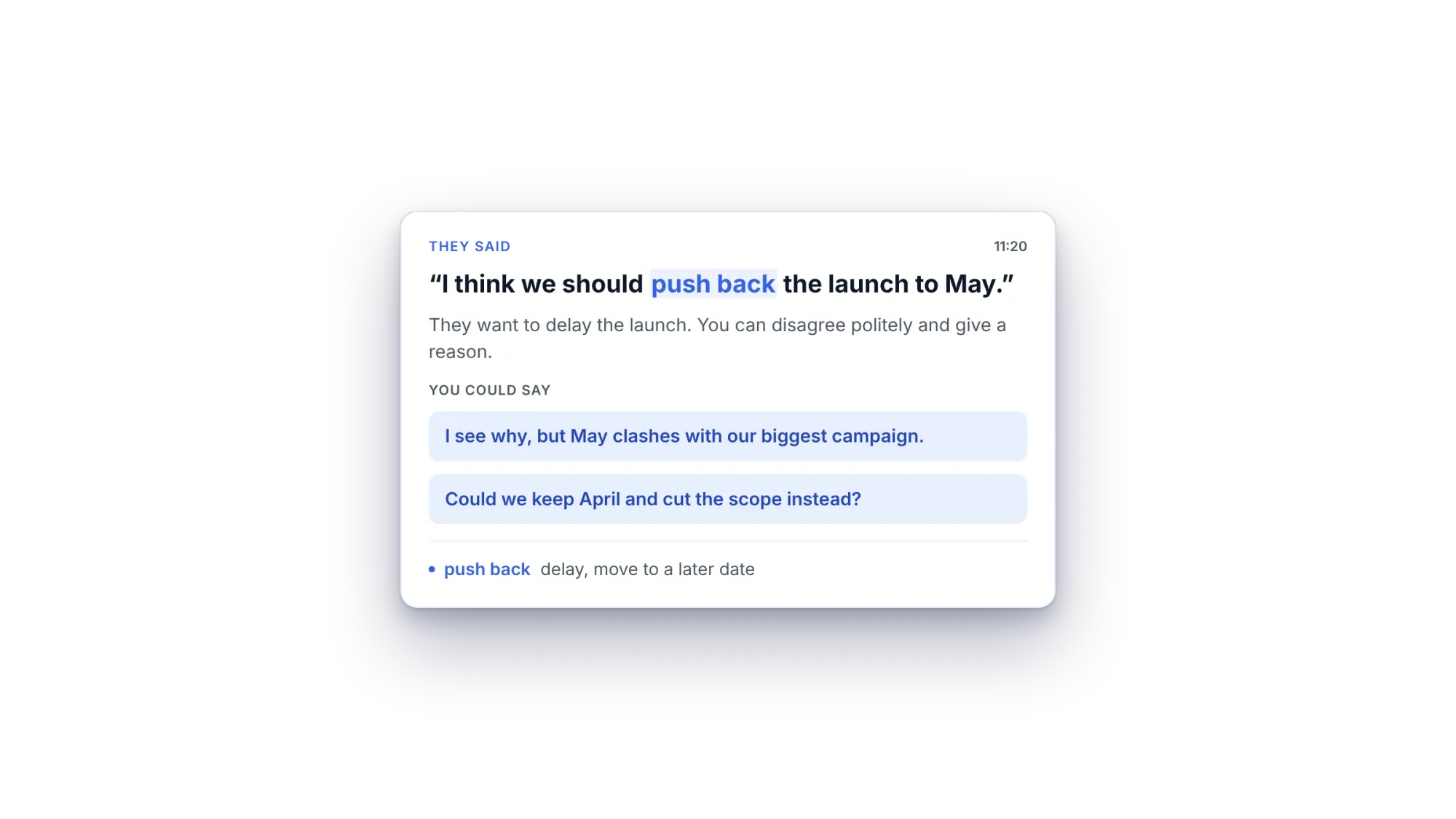
In many English-speaking workplaces, direct disagreement like “No, that's wrong” sounds rude. The usual pattern is: acknowledge, then disagree, then give a reason or an alternative.
- “I see what you mean, but I'm worried about the cost.”
- “I see it a bit differently.”
- “I'm not sure that works, because the team is fully booked in May.”
- “That's a fair point. Have we considered…?”
- “Could we look at another option?”
- “I'd push back a little on that.” (polite but clear)
Softening words help: a bit, slightly, I'm not sure, maybe. They don't make you sound weak. In English meetings, they make you sound professional.
Asking for opinions and checking understanding
- “What do you think, Marco?”
- “Does anyone have any concerns?”
- “How does that sound to everyone?”
- “Just to make sure I understand: you'd like us to start next week?”
- “Sorry, could you say that again? You cut out for a second.”
For many more ways to check meaning without sounding lost, see our guide on how to ask for clarification.
Moving the discussion on
Meetings drift. These phrases bring them back without sounding bossy.
- “Let's move on to the next point.”
- “In the interest of time, let's park this for now.”
- “Can we take that offline?” (discuss it later, separately)
- “Let's come back to the main question.”
“Park this” and “take it offline” are idioms. If they're new to you, our list of business idioms you'll hear in meetings explains them with examples.
Wrapping up
A good ending makes sure everyone knows who does what, and by when.
- “Let's wrap up here.”
- “So, to summarise: we launch on 3 April, and Anna updates the timeline.”
- “Let's recap the next steps.”
- “Who's going to take that on?”
- “Can we agree on a deadline for that?”
- “Thanks, everyone. I'll send the notes after the call.”
If you're not running the meeting, you can still help: “Before we finish, can we confirm the next steps?” It shows ownership and makes sure you leave with clear tasks.
British and American differences
Most meeting phrases are the same everywhere, but a few differ:
- Schedule: British speakers often say “diary” (“I'll check my diary”), Americans say “calendar”.
- Tabling an item: in British English, “table” means discuss it now. In American English, it means postpone it. Ask if you're unsure.
- Directness: British English tends to soften more (“I'm not sure that's quite right”), American English is often more direct (“I don't think that works”). Both are polite in their context.
Practise before the real meeting
Phrases stick when you use them out loud. Pick three from this page, one to open, one to disagree, one to wrap up, and use them in your next call.
If you'd like support during the call itself, Sidecue's Language coach runs in Chrome next to Google Meet, Zoom or Teams. A few seconds after someone speaks, it shows their exact words, what they meant, idioms explained at your level, and phrases you could say back. Everything useful is saved on your Phrases page, so you can review it after the meeting.
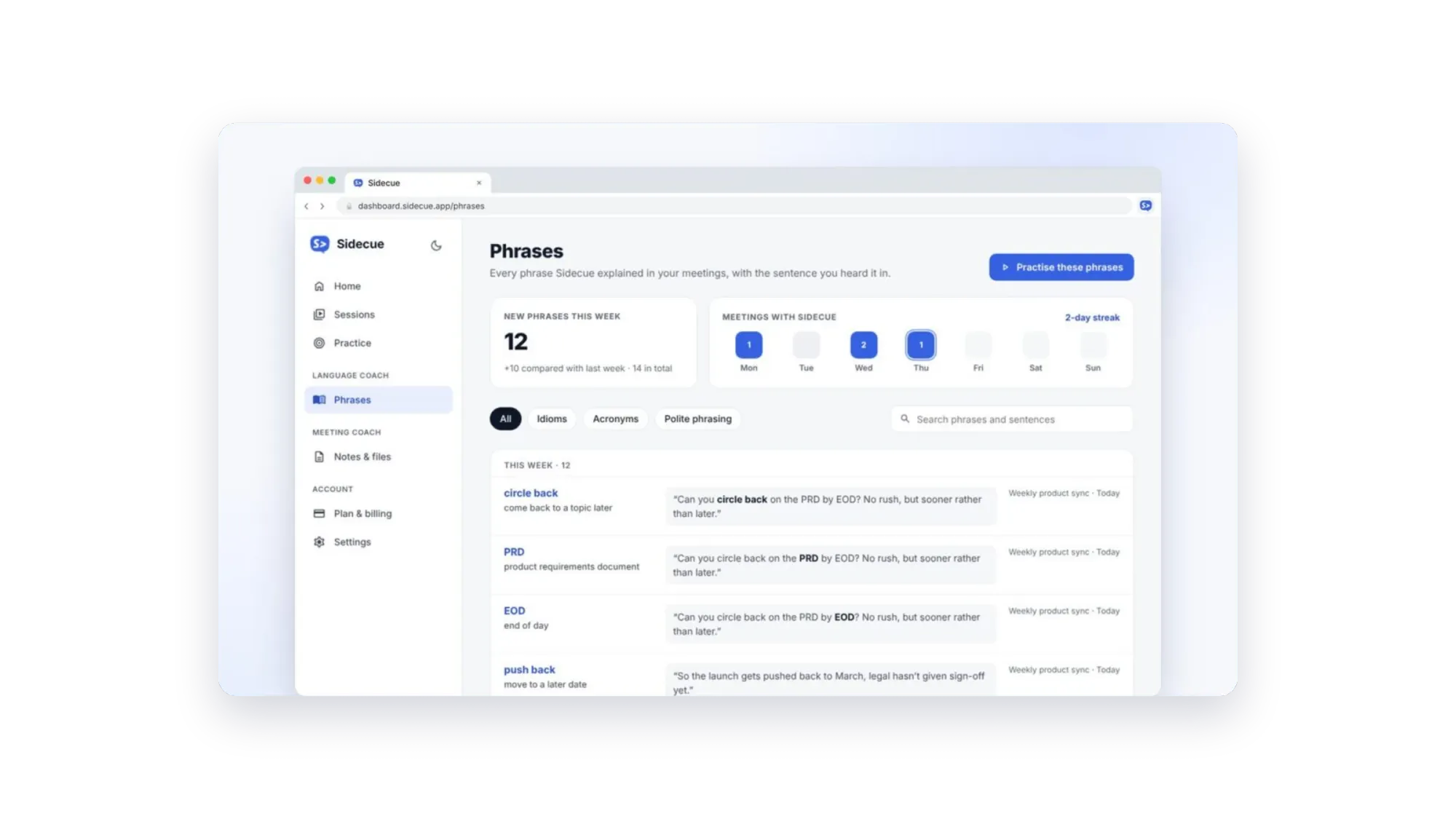
You can try it first in a practice call, with no real meeting at stake. The free plan includes 30 minutes a month.
Add Sidecue to Chrome for free
FAQ
How do I sound more confident in English meetings?
Prepare your first sentence, speak a little slower than feels natural, and use signal phrases like “Quick update from my side” and “That's all from me”. Confidence comes more from structure than from perfect grammar. Our guide to speaking up in meetings as a non-native speaker has more tips.
Is it rude to interrupt in English meetings?
Not if you use a softening phrase like “Sorry to jump in” and keep your point short. In fast online meetings, polite interrupting is often the only way to be heard.
What if I don't understand what someone said?
Ask. “Sorry, could you say that again?” is normal in every meeting, especially online. If fast speech is the main problem, see our tips to improve your English listening.
Written by
Questions or thoughts? Share them below.
Keep reading
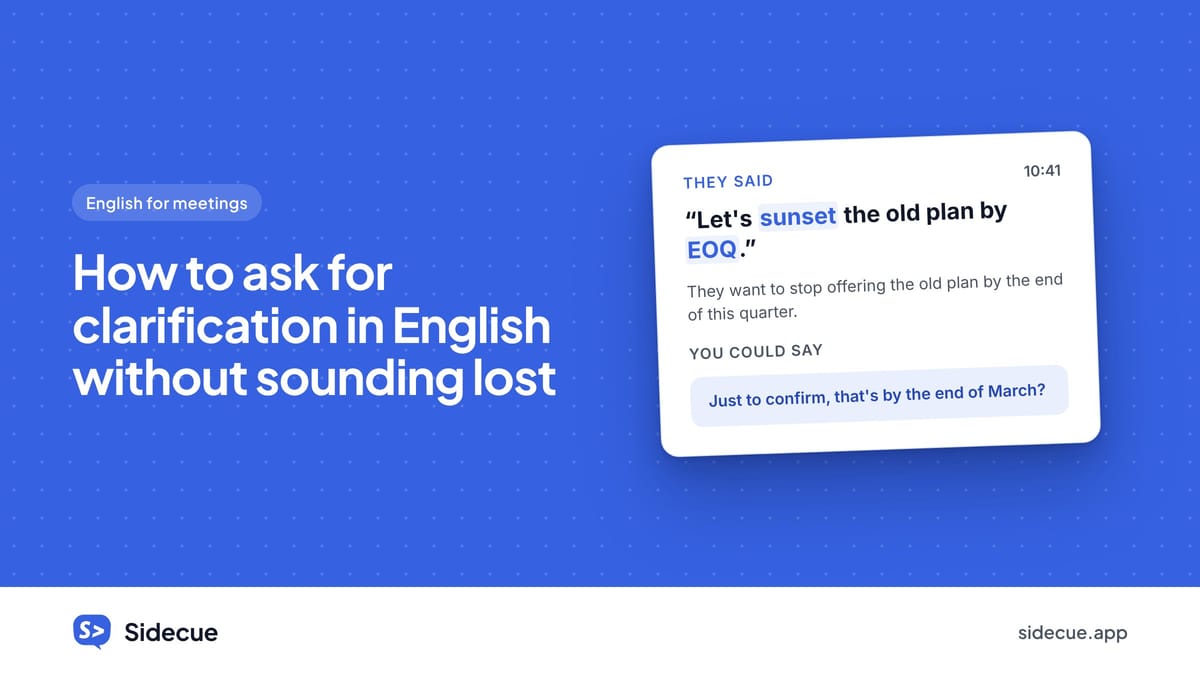
How to ask for clarification in English without sounding lost
Natural English phrases to ask for clarification in meetings: when you didn't hear, don't know a word, or want to check what someone meant.
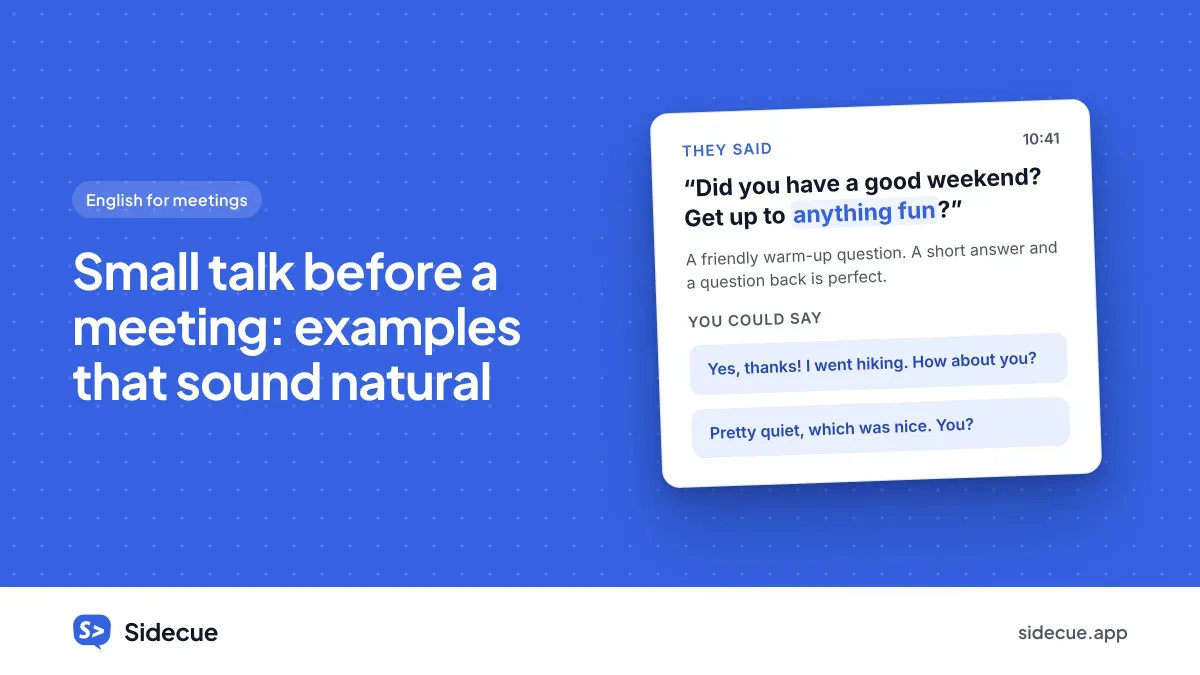
Small talk before a meeting: examples that sound natural
Natural small talk questions and answers for the first minutes of a meeting, safe topics, and how to move smoothly from small talk to business.
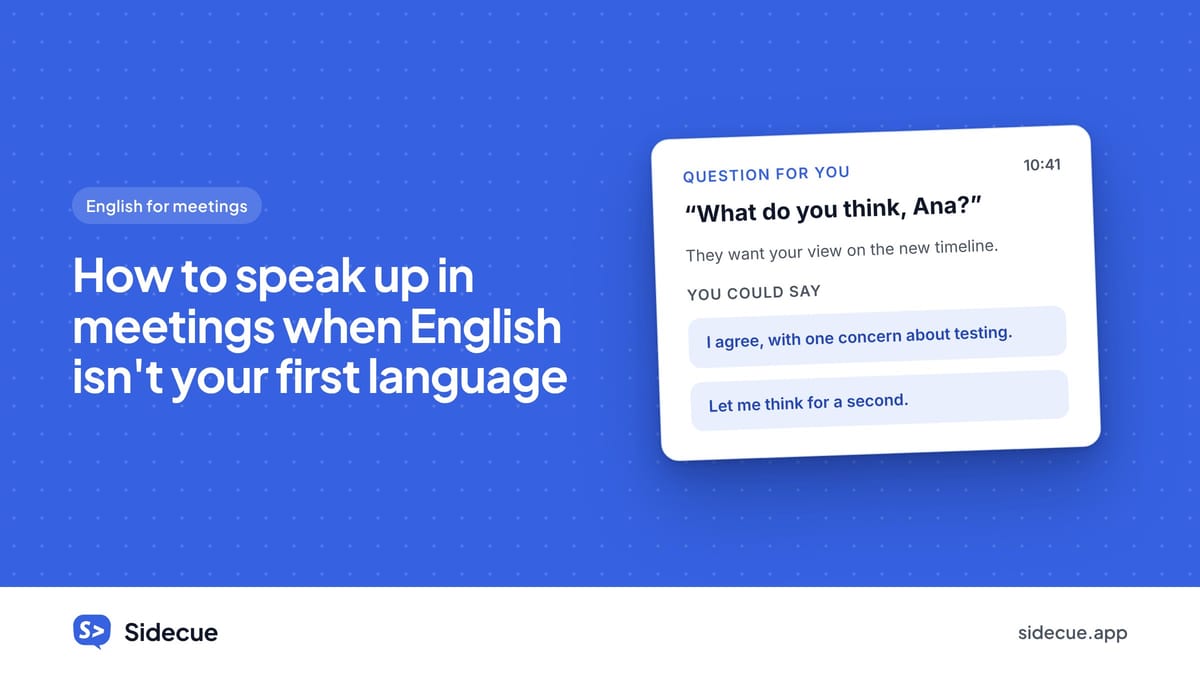
How to speak up in meetings when English isn't your first language
Practical ways to join the conversation, buy time, disagree politely and answer questions on the spot when you work in your second language.